

How to Qualify for BISP 2026 Full Eligibility Criteria Explained
BISP 2026
BISP 2026 continues to be one of Pakistan’s largest social welfare initiatives, helping millions of low-income families meet their basic needs. As BISP enters 2026, many people are asking the same question: How can I qualify for BISP 2026?
Understanding the eligibility requirements is important before applying. Whether you are registering for the first time or checking your current status, knowing the latest criteria can save you time and prevent unnecessary complications.
What Is BISP?
The Benazir Income Support Programme is a government-funded financial assistance program designed to support deserving and financially vulnerable households across Pakistan.
The program provides cash assistance to eligible families to help them manage essential expenses such as:
- Food and groceries
- Children’s education
- Healthcare needs
- Household necessities
BISP uses data collected through the National Socio-Economic Registry (NSER) to determine eligibility.
You Can Also Read : BISP PMT Score 2026
Why Eligibility Matters for BISP 2026
BISP aims to ensure that financial assistance reaches families who genuinely need support. To achieve this, the government uses specific eligibility standards to identify deserving households.
Applicants must meet these requirements before they can receive payments under the program.
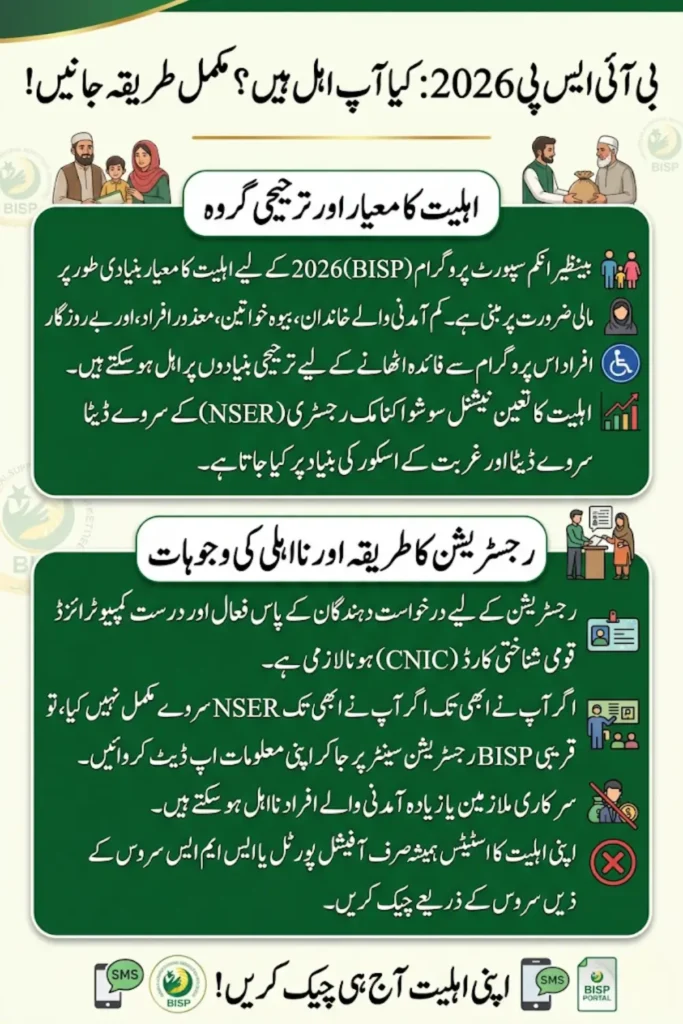
BISP 2026 Eligibility Criteria
Household Must Be Financially Vulnerable
The primary requirement for BISP is financial need. Families with limited income and insufficient resources are given priority.
Generally, eligible households include:
- Low-income families
- Unemployed individuals
- Daily wage workers
- Widows without stable financial support
- Persons with disabilities facing financial hardship
- Families living below the poverty threshold
Valid CNIC Is Required
Applicants must possess a valid Computerized National Identity Card (CNIC).
Important points:
- CNIC must be active and valid
- Information should match official government records
- Expired CNICs should be renewed before registration
NSER Survey Participation
The National Socio-Economic Registry survey plays a major role in determining eligibility.
During the survey, information such as the following is collected:
- Family size
- Income level
- Employment status
- Living conditions
- Property ownership
Families that have not completed the NSER survey may need to update their information through the nearest BISP registration center.
Poverty Score Requirement
BISP uses a poverty score generated through NSER data.
Applicants with lower poverty scores generally have a higher chance of qualifying for assistance.The exact score threshold may vary based on government policies and updates.
You Can Also Read : 8171 Ehsaas Program CNIC Check
Who Is More Likely to Qualify for BISP 2026?
Several categories of individuals often receive priority consideration.
Widows
Widowed women with limited financial resources are among the key beneficiaries of BISP assistance programs.
Persons with Disabilities
Individuals with disabilities who face financial difficulties may qualify if they meet the required conditions.
Orphan-Supporting Households
Families responsible for caring for orphaned children may be considered eligible based on their economic circumstances.
Unemployed Individuals
People without stable employment or regular income may qualify if their household financial condition meets program requirements.
Who May Not Qualify for BISP 2026?
Certain factors can lead to disqualification from the program.
Government Employees
Some government employees and individuals receiving higher government salaries may not be eligible.
High-Income Individuals
Applicants with significant income, business earnings, or financial assets may fail the eligibility assessment.
Property Owners With Strong Financial Status
Individuals who own multiple properties or valuable assets may be excluded from assistance.
Tax Filers With Strong Financial Profiles
People with higher taxable income and strong financial records may not qualify for BISP support.
Incorrect Information Submission
Providing false or misleading information during registration can result in:
- Application rejection
- Payment suspension
- Permanent disqualification
Documents Required for BISP Registration
Applicants should prepare the following documents before visiting a registration center:
- Original CNIC
- Registered mobile number
- Family information
- Disability certificate (if applicable)
- Death certificate of husband (for widows, if required)
Keeping documents updated can speed up the verification process.
How to Register for BISP 2026
Step 1: Visit the Nearest BISP Registration Center
Go to your nearest BISP office or registration center.
Step 2: Complete Verification
Officials will verify your personal and family information.
Step 3: Participate in the NSER Survey
If your household data is outdated or missing, you may be asked to complete or update the survey.
Step 4: Wait for Eligibility Review
Your information will be reviewed through the BISP system.
Step 5: Receive Confirmation
Eligible applicants receive confirmation through official communication channels after successful verification.
How to Check BISP Eligibility Status
After registration, applicants can check their status using official BISP services.
Common methods include:
- BISP online portal
- SMS verification services
- BISP help centers
- Registration offices
Always use official channels to avoid scams and misinformation.
Common Reasons for BISP Application Rejection
Understanding common rejection reasons can help applicants avoid mistakes.
Incomplete Family Data
Missing information during registration may delay or reject an application.
Invalid CNIC
An expired or incorrect CNIC can create verification issues.
Updated Financial Status
Families whose economic condition has improved may no longer qualify.
Survey Information Mismatch
Differences between submitted information and official records can trigger rejection.
Tips to Improve Your Chances of Qualification
Follow these practical tips:
- Keep your CNIC updated
- Ensure NSER data is accurate
- Provide truthful information
- Update family records when necessary
- Respond promptly to verification requests
- Use only official BISP channels
Accurate information helps ensure a smoother application process.
Conclusion
Qualifying for BISP 2026 depends on meeting specific financial and household eligibility requirements established by the government. Families facing genuine economic hardship, widows, unemployed individuals, and other deserving groups may be eligible for support after successful verification.
Before applying, ensure your CNIC is valid, your NSER information is up to date, and all details provided are accurate. Following the correct registration process can improve your chances of receiving financial assistance through BISP and help your family benefit from the support available in 2026.
Frequently Asked Questions (FAQs)
What is the main eligibility requirement for BISP 2026?
The main requirement is financial need. BISP primarily supports low-income and deserving households.
Is a CNIC mandatory for BISP registration?
Yes. A valid CNIC is required to complete registration and verification.
Can widows apply for BISP 2026?
Yes. Widows who meet the financial eligibility criteria may qualify for assistance.
How is BISP eligibility determined?
Eligibility is generally assessed using NSER survey data, poverty scores, and household financial conditions.
Can a person be removed from BISP after approval?
Yes. If financial circumstances change significantly or incorrect information is discovered, benefits may be suspended or discontinued.
